Spray & Grow Kit FAQ
Section 01
Getting started
Are North Spore Spray & Grow mushroom kits organic?
Yes — they are USDA certified organic.
What is the shelf life? How should I store my kit before use?
Inside your Spray & Grow Kit is a living organism, so we recommend activating it upon receipt. If you need to wait, store it in a cool, dry place out of direct sunlight, or in the fridge for up to 6 months.
All species used in our kits are very vigorous — after a few weeks of storage they may start fruiting inside the bag. That's fine, but it surprises some people, which is why we have activation and storage recommendations.
Should I take the block out of the box and bag?
No — Spray & Grow Kits should stay in the bag (and inside the box) while they grow. Remove the front panel of the box along the perforated lines, then cut an X into the exposed plastic. Enough oxygen gets through this cut and it directs the mushrooms to form there. Leave the plastic flaps of the X on the bag — they help retain moisture. The mushrooms will grow out of the X easily; no need to open it further as they fruit.
Full instructions for each variety:
How often and how much should I water my kit?
You don't need to empty the bottle each time — just get the cut area of the bag nice and damp. Try 5–10 sprays each session. If the surface seems very dry when you spray it next time, increase the frequency or amount slightly. In dry climates or with AC running, a humidity tent can help prevent the block from drying out.
Why is my new kit already growing mushrooms?
A very vigorous kit — totally normal. There is a filter on the bag to provide fresh air, and mycelium will try to grow towards it. If the mushrooms are easily accessible, break them off and compost them so you can start fresh.
Section 02
Harvesting
When should I harvest my mushrooms?
The image on the front of your box shows the mushrooms at their ideal harvest stage. The general rule: harvest before caps flatten or become concave. For lion's mane, harvest before they yellow and get mushy. Mushrooms can double in size each day, so keep a close eye on them.
For oysters, harvest while the cap edge is still slightly curved under. They'll store better and hold their shape. For lion's mane, harvest when the teeth are ¼–½″ long before any yellowing.
To harvest, reach around the base of the cluster and twist to pop it off the block. A knife works too. Remove any loose debris before starting to spritz again.
How do I harvest my mushrooms?
Hold the cluster near the base and spin or twist. A knife works too. Clean off any loose bits from the kit before continuing to spray, and trim off any bits of sawdust from the block before cooking.
Do I need to cook my mushrooms?
Yes — always cook mushrooms thoroughly before eating. They contain chitin, a compound that's difficult to digest raw. Heat breaks it down, making mushrooms much easier on your body.
How many flushes will one kit produce?
We guarantee at least one flush, but with patience and care you can often get a second, third, fourth, or even fifth. Your first flush should yield somewhere between ½ and 2 lbs., varying by species and growing conditions. Each subsequent flush will likely be smaller as the fungi use up nutrients in the substrate.
How do I get a second flush from my kit?
After harvesting, continue spraying daily. If the block looks dry, cover it with a humidity tent. In around 2 weeks, you should see new pins forming. There's no need to take the block out of the bag or cut a second X.
If no progress after a couple of weeks, soak your block. Take it out of the box and set it cut-side down in a bowl of cool water — most species only need 20 minutes. Lion's mane only needs 5–10 minutes; its mycelium is delicate and the block can break apart if soaked too long.
After soaking, drain cut-side down for 10 minutes, pat dry with a towel, then return to the bag and box with the cut facing out. Spray 2–3× daily.
Looking for a third, fourth, or fifth flush? See our guide on how to get more life out of your kit.
What do you mean by "fruiting" and "flush"?
Mushrooms are the reproductive structure of a fungus — the way plants produce fruit containing seeds, fungi produce mushrooms containing spores. When a fungus starts producing mushrooms, we call that fruiting.
The block in your kit is mostly mycelium (the vegetative body of the fungus) and its food source (supplemented sawdust). Once the mycelium has fully established itself and used up nutrients, it gets a cue — a temperature or oxygen shift — to fruit and produce mushrooms so it can move on to a new food source.
A flush refers to many mushroom fruiting bodies forming at once. Most cultivated fungi produce mushrooms simultaneously, which is why we call it a flush.
Section 03
Troubleshooting
What is this white stuff? Is my kit growing mold?
Chances are it's not mold — it's mycelium. Your kit contains an amended sawdust block with mushroom mycelium growing through it, which may appear as a soft, white covering. That's healthy and normal. Lion's mane mycelium tends to be fine and faint; oyster mycelium can develop into a thick, leathery mat. If you're unsure, send us a photo and we'll help identify what's happening.
If your kit has black, green, or orange patches, it may have been damaged in transit. Reach out with a photo and we'll make it right.
My block has cracks, looks dry, or seems off.
Inspect your kit on arrival and keep the packaging. Each kit has a batch-specific sticker on the substrate bag — we use these for quality control. If you notice green or black discoloration or foul smells before opening the bag, contact us with photos. A healthy kit should have white or off-white mycelium weaving through brown substrate and smell pleasantly earthy.
If the block is broken on arrival: while still in the bag, gently press the block back together and give it extra time to recover before cutting it open — about a week. If the bag is already open, smoosh the block together as best you can, keep it moist with a humidity tent (use a trash bag with plenty of ½″ holes), and mist the inside daily. When you see pins forming, remove the tent and keep misting.
If the block looks "dead" or like nothing is happening: lion's mane mycelium is famously faint and often looks uncolonized — if the block holds together, it's probably fine. For other species, the block may just need a few days to recover from transit. Keep it misted. We guarantee all kits will fruit within two weeks, or we'll send a replacement.
If the block seems dry and hasn't produced yet: try a humidity tent (trash bag with ½″ holes, draped over the block, misted inside daily).
If the block is dry after producing once or twice: soak it cut-side down in a bowl of water — 1 hour for oysters, 10–15 minutes for lion's mane (its mycelium is delicate and can break apart if soaked too long). Pat dry before returning to the box. Mist 2–3× daily.
Why did my kit start then stop growing?
Usually pins stop growing when humidity drops around the block. Don't panic — the block still has all the food it needs. Pick off the dried-up pins, let the block rest for a week on a plate to dry out slightly, then soak it in cold water for 20 minutes. Drain, return to the bag, and start again with a humidity tent if you didn't use one the first time. Spray 2–3× daily when you see new pins forming.
Why do my mushrooms look weird?
Young mushrooms can look strange as they emerge. Leggy, stringy, or sparse mushrooms need more airflow — try moving them somewhere more open or pointing a fan near them. Abnormally shaped mushrooms that aren't getting airflow may need more humidity; try a humidity tent.
When lion's mane yellows, it's usually a moisture issue. Spray from further away to give a fine mist rather than a soaking. If they're yellowing and not wet, they're likely past peak maturity — time to harvest and reset for the next flush.
Pale caps likely need more natural light. Keep kits out of closets or cabinets; ambient sunlight helps them develop their characteristic color.
How do I make a humidity tent?
A humidity tent creates a moist microclimate that helps blocks thrive. We recommend one in dry conditions, when a block has been broken up, or if you can't water one day.
Take a semi-transparent trash bag or loose-fitting plastic bag and put plenty of ½″ holes throughout — mushrooms need to breathe. Drape over your kit and mist the inside or the X cut on your block several times a day. Use chopsticks, a plastic tote, or anything handy to prop up the bag if needed. Remove the tent when you see pins forming and continue misting.
Help! My kit has gnats!
Any home with houseplants, a compost bin, or unrefrigerated fruit will likely have a small gnat population hiding somewhere — sometimes even in the pipes. The moment mushroom kits arrive, gnats will seek them out, especially in warmer months.
Identify the source in your home and treat it. You can also make a natural repellent to spray on the outside of your kit: a few drops of dish soap + 1 tablespoon vinegar + 1 tablespoon baking soda per cup of water. Reapply if gnats return.
Note: Do not spray this mixture directly on the mushrooms. For persistent issues, gnat sticky traps or a small plug-in trap like the Zevo work well near your kit.Section 04
Species-specific
My baby golden oysters look like lion's mane!
When they first pin, baby golden oysters look similar to lion's mane — they start as white, blob-like clusters. As they mature, the caps develop their signature yellow hue and shelf-like structure. Watch the growth process below.
Is my grow kit the correct species?
Your kit was inoculated in a sterile environment with a selected mushroom culture, so a competing species is incredibly unlikely. If you'd like confirmation of what's growing, take a photo and email it to us. Save the image on the front of your kit bag or box for reference.
We get this question most often with golden oyster kits. As they begin to pin they can resemble lion's mane — white and blob-like at first, developing yellow caps and shelf structure as they mature. If you're unsure, wait a day or two to see if the yellow appears. We do occasionally pack a bag in the wrong box — if that sounds like what happened, reach out and we'll make it right.
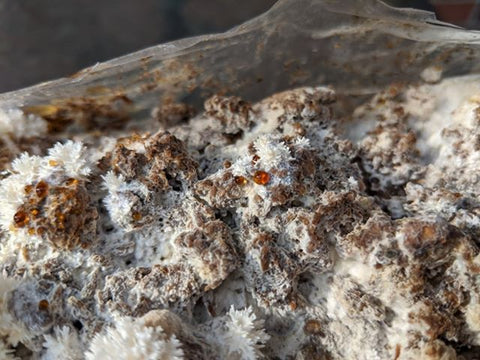
What are the amber colored beads growing on my kit?
That's mycelial exudate — a byproduct of the mycelium's metabolic process, natural and harmless. Fungi digest outside their bodies, releasing enzymes into their environment to break down materials before absorbing them. Those amber beads are essentially digestive juices.